Introduction
Are you struggling to choose the right borewell type for your water needs? Selecting the correct borewell types can make all the difference in efficiency, sustainability, and long-term cost savings. Whether for agriculture, industrial use, or household water supply, understanding the various borewell drilling methods available is crucial.
In this comprehensive guide, we’ll break down five essential borewell types, their advantages, and ideal applications—helping you make an informed decision. By the end, you’ll know exactly which borewell type aligns with your requirements.
1. What Are Borewell Types?
Borewells are deep, narrow wells drilled into the earth to extract water from underground aquifers. Depending on factors like soil composition, water depth, and usage requirements, different borewell types are used.
Key Considerations Before Choosing a Borewell Type:
- Water table depth – Shallow vs. deep aquifers.
- Soil/rock hardness – Soft soil vs. hard rock formations.
- Purpose – Irrigation, drinking water, or industrial use.
- Budget – Cost of drilling and maintenance.
Let’s explore the top 5 borewell types in detail.
2. 5 Essential Borewell Types for Every Need
2.1 Dug Borewells (Shallow Borewells)
Dug borewells are traditional wells excavated manually or with light machinery. They are ideal for areas with shallow water tables (typically less than 50 feet).
✔ Best for:
- Rural households
- Small-scale irrigation
- Low-cost water extraction
⚠ Limitations:
- Susceptible to contamination
- Limited depth
2.2 Bore-Blaster Borewells
Bore-blaster borewells use controlled explosives to break hard rock formations, making them ideal for granite and basalt areas.
✔ Best for:
- Rocky terrains
- Industrial water supply
- Municipal water projects
⚠ Limitations:
- Requires specialized expertise
- Higher cost than regular drilling
2.3 Cable Tool Borewells (Percussion Drilling)
Cable tool drilling involves repeatedly lifting and dropping a heavy bit to break rock formations.
✔ Best for:
- Hard rock drilling
- Minimal water requirement zones
- Precision drilling for deep wells
⚠ Limitations:
- Slower than rotary drilling
- Not ideal for soft soil
2.4 Rotary Borewells (Most Common Type)
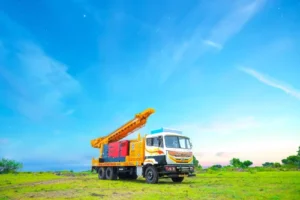
Rotary borewells use a rotating drill bit to penetrate soil and rock, making them the most widely used borewell type.
✔ Best for:
- Fast and efficient drilling
- Deep aquifer extraction
- Large-scale industrial use
⚠ Limitations:
- Requires large equipment
- Higher initial cost
2.5 Reverse Circulation Borewells
This advanced method uses a dual-wall drill pipe to remove cuttings efficiently, making it ideal for deep water extraction.
✔ Best for:
- High-yield wells
- Mining and industrial applications
- Municipal water supply
⚠ Limitations:
- Expensive machinery
- Complex installation
3. How to Choose the Right Borewell Type?
Selecting the best borewell drilling method depends on:
✅ Geological Conditions
- Soft soil? Use rotary borewells.
- Hard rock? Consider bore-blaster or cable tool borewells.
✅ Water Demand
- High-volume needs? Reverse circulation borewells work best.
- Household use? Dug or rotary borewells suffice.
✅ Budget & Longevity
- Low budget? Dug borewells
- Long-term investment? Rotary or reverse circulation
4. Frequently Asked Questions (FAQ)
Q1. What is the most common borewell type?
A: Rotary borewells are the most common due to their efficiency and adaptability to various soil types.
Q2. Which borewell type is best for hard rock areas?
A: Bore-blaster and cable tool borewells are ideal for rocky terrains.
Q3. How deep should a borewell be?
A: Depends on the water table. Typically, 100-500 feet for reliable extraction.
Q4. Can borewells dry up?
A: Yes, due to over-extraction or drought. Proper groundwater recharge helps.
Q5. How much does a borewell cost?
A: Costs vary:
- Dug borewells: ₹10,000 – ₹30,000
- Rotary borewells: ₹50,000 – ₹1,50,000
- Reverse circulation: ₹2,00,000+
5. Conclusion & Call to Action
Choosing the right borewell type ensures efficient water extraction and long-term savings. Whether you need a dug borewell for household use or a reverse circulation borewell for industrial needs, consider factors like soil type, depth, and budget.
🚀 Need Expert Advice? At SV Drillers, we specialize in borewell drilling tailored to your needs. Contact us today for a free consultation!
CSV Keyword & Link Reference
Borewell types, https://svdrillers.com/borewell-types, Dug borewells, https://svdrillers.com/dug-borewells, Borewell drilling methods, https://svdrillers.com/borewell-drilling-methods, Cable tool drilling, https://svdrillers.com/cable-tool-drilling, Rotary borewells, https://svdrillers.com/rotary-borewells, Groundwater recharge, https://svdrillers.com/groundwater-recharge